Dedication and Introduction
This paper is dedicated to Glenn E. Burress, Ph.D., who died on April
1, 2001, as he was preparing a paper to which this one was to be complementary.
Most of the ideas in this paper were derived from many weeks of private
seminars in which he generously taught me all the things I had suspected were
left out of Economics as it is taught elsewhere. While few of the ideas here
can be claimed as original, nonetheless they are my interpretations of what I
learned, and I hope he would have forgiven me if I get things wrong.
What Glenn saw rings true not because it is logically correct but
because it corresponds with observed reality. At a superficial level,
Glenn’s model could be set beside other models and their respective
validity could be debated endlessly. One of Glenn’s many insights,
however, was that an erroneous view cannot be corrected from within the
framework in which that view is held(1).
It is not, in my view, sufficient to lay out Glenn’s model; it is
necessary to look one level below to explain his distinctive methodology and
examine the reasons why he had such difficulty in being heard among economists.
Glenn’s circumstances had precedents in such tortured scientists as
Galileo(2),
Semmelweis(3), and Wegener(4). Were Glenn himself to say this,
it would sound presumptuous. Fortunately, I can say it in good conscience.
There is a common cause to this pattern of rejection and posthumous
vindication, and it is time that this cause be understood and dealt with lest
others become oppressed by ignorance. Looking for these underlying causes of
error leads us to moral questions of responsibility and duty, of perception and
bias, of values and self-deception, and even of the difference between
mathematics and science. It will not be possible to say it all here, but this
is the basis for further explanation.
This paper is written for a seminar on poverty. It was intended to
accompany Glenn’s incomplete complementary paper in which he would show
the connection between a bias of the big players in the economy that creates an
underclass and preempts access to a decent life for the majority. It should be
added that Glenn’s deep concern with poverty and inequality motivated his
work. The major part of this paper is not a bill of complaints, however, but a
model for alternative policies based on sound logic, clear thinking, and
historical precedent. While I cannot supply Glenn's full arguments, a section
of this paper will outline the part that Glenn's macro-economic model could
play in mitigating poverty in industrialized economies.
Greenspan’s Aviation Metaphor
Before there was Alan Greenspan there was Paul Volcker as chairman of
the Federal Reserve Board. Volcker served from 1979 until 1987. He pursued a
restrictive monetary policy to combat inflation but was forced by a stagnant
economy and high unemployment to support increased monetary growth during the
mid-1980s. On his retirement the unemployment level was about seven percent,
inflation had abated, and Volcker testified that it would be inflationary for
the unemployment level to fall below that point.
A recent capsule biography of Alan Greenspan reads(5):
Greenspan, Alan,
1926-, American economist, chairman of the
Federal Reserve Board (1987-), b. New York City. A private economic consultant
(1954-74, 1977-87), Greenspan served (1974-77) as chairman of the
president’s Council of Economic Advisers during the administration of
President Ford. From 1981 to 1983 he chaired the bipartisan National Commission
on Social Security Reform, which reformed the financing of the U.S. Social
Security system to assure its solvency. In 1987, President Reagan appointed him
chairman of the Federal Reserve System, replacing Paul Volcker. Influenced by
the philosophy of Ayn Rand, Greenspan is a strong supporter of the free market
and an opponent of government intervention in the economy. As Federal Reserve
chairman, he has emphasized controlling inflation over promoting economic
growth and has won widespread praise for his deft manipulation of interest
rates.
Despite Volcker’s recommendation, Greenspan decided to lower
interest rates cautiously and see what would happen. As he lowered the rate,
unemployment declined, but inflation remained low and manageable. Then he got
cold feet.
What Greenspan had done right was to try something in
“real-space”, not “conceptual-space”. The experiment in
lowering interest rates and providing liquidity had worked beneficially but was
not believed and integrated into forward planning. What he had done was briefly
adopt a policy compatible with Burress’ macro-economic model. Then he
reverted to an inappropriate micro-economic model based on an ideological view
of the marketplace as the solution to all economic questions.
When Adam Smith described the market with his famous “invisible
hand” metaphor, he was not being prescriptive but descriptive. He was
explicitly and clearly writing of a situation in which each actor was, in
principle, on an equal basis with all others, were — in a sense —
atomic entities. This is the realm of micro-economics, the behavior of
individuals and small firms. Smith made a point that businessmen, generally,
were short-sighted and would, when an opportunity to improve their own lot was
at hand, combine against the common good. The common good is the realm of
macro-economics. Greenspan saw the pieces separately but did not grasp the
whole.
He saw the increase in productivity as the basis for low inflation but
did not see productivity as an endogenous economic variable. He saw labor cost
as driving inflation even though labor costs were having a diminishing effect
on total costs and rising wage levels were a both a source and consequence of
general prosperity. He began reducing liquidity by raising interest rates
prematurely in an unjustified anticipation of inflation, bringing about the
very conditions he was trying to avoid. One can detect in his actions the
peculiar value-judgments of the class-bound, denigrating the contributions of
the “common people” to the quality of society. Under this view, labor
is viewed solely as a cost, not as a customer(6). He “justified”
premature stringency by anticipating a demand for goods by an
“overpaid” labor force. We know it was premature because there were
no reports of actual inflation beyond a secular trend.
While his policies were perverse, Greenspan’s rhetoric was sound.
He spoke of a “soft landing”, a metaphor from aviation in which an
airplane is leveled off just as it touches down near the start of a runway.
Airplanes and economies share the fundamental nature of being complex systems
— “organisms” might be a better word — that include
feedback paths and non-obvious internal connections. The behavior of the whole
cannot be understood by a naïve understanding of the behavior of the
components. In such systems, timing is crucial. A mistake in timing cannot be
corrected simply by applying a counter-force after the mistake has become
obvious. To extend Greenspan’s metaphor, he was a pilot who did not know
his altitude with respect to the runway threshold and stalled out several
hundred feet above the runway. (We can’t be sure at this writing whether
it will be merely severely bumpy or a destructive crash. In any event, there
will at least be severe injuries to innocent passengers.) A good metaphor, like
a good intention, does not guarantee a good result; the Devil is in the
details. Nor is it good enough to criticize Greenspan’s policies from a
position of hindsight. This brings us to Burress’ model which had been
articulated long before Volcker was Chairman.
Burress’ Macroeconomic Model
(7)
Words, equations, diagrams are all metaphors for some
“reality” for the purpose of conveying understanding from one mind to
another. As metaphors, they represent reality but are not the reality they
represent. A metaphor that conveys a precision beyond what is known to be real
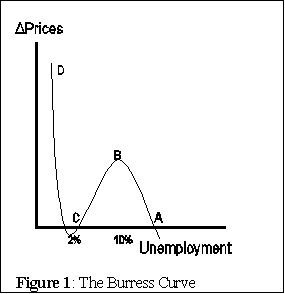
misrepresents reality. The Burress curve shown in Figure 1 does not purport to
convey a precise relationship but does fairly represent the underlying
structure of the economy. The numbers represent rough estimates of NAIRU(8) (2%) and a point at which social
perceptions about the state of the economy change (10%). Over extended periods,
the curve may be plastic — depending on the historical, ideological, and
legal environments — but the general shape is stable and of great
significance. The axes are deliberately not scaled. The model indicates the
“altitude” that Greenspan should have aimed at is about two percent
unemployment.
The significant part of the curve lies between points B and C. Note
that it has a positive slope, the reasons to be explained shortly. This
contrasts with the assumption made by Volcker and Greenspan that low
unemployment forces rising prices, derived from a naive application of
micro-economic theory of markets. The theory of the whole economy is distinct
from the theory of the micro-economy and there is no reason to apply market
assumptions to analysis of the whole.
Greenspan correctly noted that increasing productivity kept costs and
hence prices low. He, like conventional economists, attributed productivity to
fortuitous engineering developments lying outside of economic theory. Indeed,
there were such developments, but the change in productivity is an endogenous
economic variable which must be included in the model if it to describe actual
economic performance. Productivity depends upon investment in tools and
processes, not on ingenious ideas which are always lurking.
Why, then, does upward pressure on prices
diminish as the economy moves down the B-C slope even as the economy warms up?
The explanation lies in the increase in system productivity (to be
distinguished from firm productivity and capital productivity) brought about by
positive feedback through the relationship of fixed and variable costs.
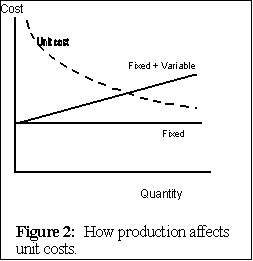
Consider here the way in which individual firms experience their costs and
their profits by consulting Figure 2.
A firm will stay in business in the long run only if its revenues at
least equal its fixed and variable costs. The fixed costs are those that it
will incur regardless of the amount of goods it produces, such as carrying of
debt, payment of rent and property taxes, accounting and legal fees, and other
things that it must do simply to be in existence. The firm has some long-run
control of these costs but in the short-run (a year or two) they cannot change.
The variable costs are those that change with the amount of product produced;
mainly labor and materials consumed in manufacture but also costs related to
number of customers and other factors that depend upon the intensity of the
firm’s activity. As business picks up, as production and sales are
increased, the proportion of the fixed costs that must be recovered in each
unit of product declines. That is, as more items are produced, the less does
each item have to bear of the fixed costs. The calculations of each firm will
be unique to its own circumstances, its prior investment in plant, its local
labor supply, its market and its competition, but the general interest of
businesses is to operate close to full capacity and to have an active economy
with as many people employed as are able to work.
When the economy is operating above and to the right of point C in
Figure 1 there may be local labor shortages or demands for certain specialized
skills that produce higher labor costs in certain areas, but the general wage
level and purchasing power will be kept down by “the iron law of
wages”. So long as there are people in need of work, they will come on to
the labor market at marginal wages. It is the mass of ultimate consumers and
their purchasing power, not the elites and their investments, that keep the
economy active and profits flowing. Among other things, the development of
consumer credit and the effects of household formation demonstrate this effect.
For the FRB to anticipate rising labor costs, which lag, by slowing down the
economy suggests at best a profound misunderstanding of how the system is
hooked together and, at worst, a deep class bias in the Marxian sense. To take
the supply-siders at their word, one must expect some increase in labor costs
as an expression of the promise of trickle-down prosperity.
Evidence
The point has been made that the proper
test of an explanatory model is not its consistency with assumptions but how
well it represents reality. Is the model a reliable predictor of actual
performance? Burress tested his curve by examining contrasting eras in monetary
and fiscal policies and observing the measured consequences of those policies.
He called the alternative paradigms “scientific” and “economic
theory,” characterized them by their assumptions about the nature of
economic problems, and tabulated the performance of the economy under the
application of the respective regimes. His findings, since refined, were
presented to Congress in 1975 and reported in “A New Approach to
Forecasting...” in The 1975 Economic Report of the President: Hearings
before the Joint Economic Committee, US Congress Part IV, pp. 1017-1052.
The periods were identified, variously, by explicit declarations, implicit
observation of operative policies, and (on occasion) by off-the-record
knowledge in Burress’ capacity as a journalist. The results of these tests
are summarized in Table I (next
page).
The Burress Curve is not a dynamic
representation. That is, time plays no part in the image. In physics, such a
curve is called a phase diagram. One may look back at history and mark on the
curve the dates at which the conditions of unemployment and inflation
prevailed, but the curve does not indicate how one moves from one point to
another or how long it might take to travel between points. The great lesson of
the curve is that for the usual range of operation the slope is positive, not
negative as conventionally assumed. Knowing where one is on the curve and where
one wants to go is only the beginning of policy-determination.
The mathematics of systems with feedback
is well known to electrical engineers and biologists. With the health and
happiness of millions at stake, however, it is a moral imperative that we
develop institutions that can cope with whatever mathematics or other
techniques that optimize economic performance. It would be unconscionable if
our techniques were limited to those that are traditionally taught to
economists merely because they are simpler. If policy-makers would look at the
evidence of history in the light of Burress' phase diagram, if they accepted
the correct slope of the curve, we already have the institutional structure to
arrive at point C, as the evidence of the Greenspan regime indicates, and
stabilize the economy near that point. Achieving a point-C economy and holding
it near there is likely to have widespread beneficial social effects. Full
employment creates its own optimism and confidence. Optimism encourages real
investment in capital goods (including education) and infrastructure.
Investment increases labor productivity permitting both lower prices and higher
profits to those providing the investment capital. The “rising tide lifts
all boats” principle would make the repair of social inequities easier. It
is a vision worth pursuing
Table I was prepared by Glenn Burress as a summary of his “real
world” observations. The periods in column B mark the times at which he
noted a change in policy. He identified two underlying policy assumptions:
anticipatory fear of inflation driven by labor costs (which is based on a
microeconomic market model) and a policy in which government acts to sustain
economic activity by providing enough liquidity for current needs. The columns
to the right record his observations of economic performance in the respective
periods.
Poverty
Applying the methods of systems science, starting with immersion in
reliable numerate data, Glenn teased out the relationship set out above and
provided a systematic explanation for why the relationship has the form it
does. Poverty is a loosely-defined social phenomenon that, like the elephant,
has diverse aspects. There is no single cause nor simple cure. Glenn's work
bears on poverty in several ways, and vice-versa. He came to see that economics
was too narrow a field to be of much use, and eventually he found that
economists had so boxed themselves into idealism that they had become
(collectively) an obstacle
The usefulness of the relationship with respect to poverty lies in its
clarification of the ordering of actual causes and effects, not mere
hypothetical assumptions. It defines the limits of policies. Points B and C
connect economics with social-psychological non-linearities. For the range of
normal operation (between C and B) labor cost does not drive inflation. Raising
the economic well-being of the least fortunate among the population actually
provides benefits to all, including the investing class. Contrary to the
hypotheses of the supply-side theorists, trickle-up economics works better than
trickle-down. Perhaps one should recall the rhetoric of the supply-siders and
compare it to the results. The prosperity promised by them came only to the
already fortunate. Homelessness and unemployment increased. The disparity among
the incomes of the various classes increased. Deregulation brought the infamous
savings and loan fiasco in which the public wound up with the bill for private
excesses. Slogans such as “government is the problem” merely avoid
the kind of careful analysis that systems methods use to bring out the nature
of reality. Finally, the model validates the objectives of the Employment Act
of 1946 which directed the FRB to seek the goal of full employment. Keynes
showed that in the C-D range of the curve (depression conditions) the
government had to supply investment not forthcoming from the private sector.
While rhetorically attacking Keynes, the Reagan administration created a
class-biased prosperity by running up the Federal debt dramatically (in the
name of national defense) and neglecting the general welfare of the
disadvantaged. Burress showed that the excuse of potential
“inflation” is an invalid reason for high unemployment.
Glenn's agony was that of Cassandra in the Trojan War. He knew the
truth, but no one (in a position to act) would hear him.
Unfinished Business
No theory, model, or formula is universal. Everything has limits
within which it works well and outside of which it produces nonsense.
Mathematicians call the area of validity the domain of a function. I wanted to
explore the limits of Glenn's model. My suspicion is that beyond monetary
management lies the relationship between real investment (in productive assets,
including education) and consumption and in limits on physical resources. It
was not possible to explore these limits because the established economics
community never recognized the relevance of Glenn's model within its range of
validity. To bring limits to the table under those circumstances would have the
likely effect of keeping the model itself off the table. It is a common social
behavior of those whose interests are vested in the status quo to shift
attention away from the challenging novelty and thereby avoid the pain of
comprehending the proposal itself.
Early in our continuing conversations I asked Glenn whether an active
economy would impinge on ecological and conservation values. His reply was that
there is no necessary connection between economic activity and such social
values. If a society orders itself on the basis of unbridled individualism, it
will tend toward inequality and the exploitation of the many by the few. If it
orders itself without regard for individuals, it will tend toward
totalitarianism, bureaucracy, and stasis. Burress viewed his model as neutral
with respect to such values. Economic activity need not be concerned
exclusively with production of material goods. People may be usefully occupied
supplying art, entertainment, science, conservation and maintenance, public
goods, education, health care, and inventiveness as much as physical product.
The Burress model is applicable to any society that uses money as a medium of
exchange and has institutions that control the supply of money. Regardless of
the details of conflicting values, following Burress’ prescription will
provide the liquidity necessary to sustain a prosperous economy.
The issues of real-world consequences brought to my mind the
formulations of Garrett Hardin. Some months before he died, I loaned Glenn a
short book by Hardin(10). I saw a deep connection
between Hardin’s hard-headed ecological analysis and Burress’
grounding in primary data. The two seemed to have complementary views of the
same elephant. Glenn had planned to read the book after he disposed of other
projects (including this Claremont conference), and I was looking forward to
exploring an expanded perspective on Glenn’s work. Glenn died before he
could open the book, and I shall always feel deprived of closure on these
issues.
A Larger Context
This ends the explanation of the nature and importance of the Burress
curve. Were the discussion to stop here, however, it would belie the true
significance of Glenn’s contributions. It would appear as just another
mathematical model to be argued about, as just another point of view about a
current issue of economic policy. It is far more than that, however. It is an
illustration of entrenched methodological and perceptual errors that impede
solutions to real problems, a cautionary example demanding explorations
unconfined to a single discipline or a specific problem.
Glenn was an excellent teacher and deserved to end his days at a
university, but, like Keynes(11), he wanted and deserved a role
in the world of human affairs, not just an ivory tower. As a journalist, for
Business Week and The Journal of Commerce, he uncovered
connections between the overt acts of the makers of economic policy and some
dark motives. Professional constraints prevented him from explicit publications
of his findings(12). His final hope was to find in
the legal system an institution in which the validity of his analysis could be
vindicated. He regarded economists as blinded by their own self-satisfaction
with their logical (mathematical) consistency regardless of observed reality.
He regarded theologians as especially privileged since their profession
entitled them to be guided by purely moral considerations. (Of course, in the
real world pastoral duties, economic obligations to family, unexamined
self-pride, and the like derogate the ideal.) He was cynical about the common
institutional formula in which chaplaincies for contending armies invoke the
blessings of God on their respective sides leaving the big question of
“right” unexamined. It is the old gambler-casino dichotomy in another
guise.
One of Glenn’s beliefs was in the possibility of developing a
unifying social science instead of a collection of bounded disciplines.
Diminishing poverty, for example, would not come out of separate moral,
political, economic, medical, sociological, psychological,... approaches. It
had to start with institutions that were constitutionally structured to extract
facts and evaluate contending theories against objective standards. Mere
self-consistency is an inadequate basis as is argument from authority. Glenn
was driven by the consciousness that while truth was suppressed and decisions
made on partial bases, real people were starving to death or condemned to
misery. He wanted immediate action and sought alliances with such institutions
as the NAACP He believed passionately that it was “criminal” to wait
for long-term education to have effect.
I haven’t the resources or the skills to take up Glenn’s
program with his total commitment. The best I can do is try to lay out some of
the pieces as I see them. It’s more words, not the action he would have
wanted, but perhaps others can cooperate. So I look for a few general issues
that – for me – underlay the opposition to Glenn’s views.
A. Science v. mathematics. Since Galileo we should
know that tests of validity must be conducted in an external “real”
world, not on the level of logical consistency with axioms. Within the last 200
years, particularly since the turn of the last century, mathematicians
themselves (e.g., Gödel) have defined the limits of their art to state the
whole truth. Yet the dominant paradigm for economic theory has been the
Euclidean axiom-hypothesis-proof technique. Alternative views of the real world
have been turned into dogmatic ideologies and used as axioms. The logical
conclusions have been, perforce, erroneous. The currently salient examples have
been: 1) the transformation of Adam Smith’s description of markets
consisting of atomic individuals into an absolute prescription for economic
decisions, and 2) the transformation of a recognition of interdependence among
individuals into a totalitarian political program, an -ism. There is a
connection between Euclid’s logic and the “ismization” of
empirical (Galilean) observations.
It is difficult to wrest our thinking from the Platonic idealism of
our classical education. It would be a Platonic mistake to label idealism as
erroneous and to be discarded, but the call of reality requires us to know the
limitations of idealism and to apply other modes appropriately.
B. 1. Psychology - Closure. Why do people make -isms
out of observations? Why do we reify socialism, capitalism, feudalism, even
anarchism,...? Why do we attach a person's name to concepts and then attack the
person (e.g., Marx)? I suspect it is a manifestation of a deep drive for
completeness, for solutions, for closure. (I also suspect that it is an
elaboration of the primitive conditioned reflex.) We can observe it trivially
in the appeal of crossword puzzles, in the Baker Street Irregulars (BSI), in
the search for the Shakespeare ciphers (and in cryptanalysis in general), and
in Bible study. For example, the BSI canonization of the Sherlock Holmes
stories gives a closed basis for resolving apparent contradictions, the
possibility of closure. Closure is a positive drive; it motivates inquiry,
experimentation, classification, both art and science. The dark side, however,
is its power to inspire in many people beliefs in the externally unverifiable
(or even false) for the sake of some internal satisfaction. Some even cling to
disproved theories because they satisfy some kind of subjective consistency. It
has been experimentally observed, for example, in common misperceptions of risk
or in “escalation behavior”, the practice of repeating a behavior
that has had a contrary consequence. The codification of the common law (or
even the establishment of uniform sentencing guidelines) might be traced to the
closure drive, and I have some doubts about whether those developments have
advanced the ends of justice. I would attribute the failure of economists
generally to grasp Glenn's work to the way it upsets their own sense of closure
(although I have recently observed remarks from a few economists that echo some
of his ideas – without attribution, of course, since he has been excluded
from the “right” institutions). Now, suppose we find that closure is
a fundamentally unattainable goal (unless forced by illegitimate
“ismization”); what should we do?
B. 2. Psychology - Values. Why did Greenspan
“jawbone” about “irrational exuberance” when faced with
speculative excesses in the stock market but act to raise interest rates on a
speculation about future inflation (not evident in current statistics) when
there was some benign lowering of unemployment rates? The Fed has the power to
curtail securities speculation by raising margin requirements; the power was
not used but would have been more persuasive than mere talk. One may infer from
this behavior a kind of class bias (in a Marxian sense). Investors and
speculators are, in this view, free individuals, not to be restrained by
government action. Never mind that such phenomena as “The Tragedy of the
Commons” (after Hardin(13)) have convincingly established
that such freedom may lead to community disaster. Working people at the
unemployment margin, on the other hand, are an undistinguished mass to be
exploited collectively for the benefit of the more fortunate. Glenn’s
phase diagram exposes the way in which everyone is made poorer by such
inequities, except for a few insiders perhaps. (In his early years as a
reporter, Glenn even uncovered explicit racism within the Council of Economic
Advisors staff and at the CEO level of the steel industry.) Certain private
values induce blindness, inconsistency, injustice, and even death when
projected on the society as a whole. In our political life, where conflicts of
values must be resolved, we habitually avoid reality by resorting to simplistic
slogans, assertions of convenient values for selfish reasons without dealing
with the conflicts. The confounding of politics with public relations may bring
short-term closure but at an appalling long-term cost.(14)
C. Institutions. There is a point of view associated
with “Libertarianism” that sees government as an impediment to
“God-given” independence and freedoms. Certainly, one may easily find
examples to support that view. I suggest, however, that the problem is not
peculiar to government, only more evident there because there is relatively
less secrecy as compared to other institutions classified as
“private”. The Devil is in an essential conflict between individual
and group, between prescription and performance, between individual desires and
common needs. One can see it, for example, in the degree of disparity in
compensation within a corporate structure and the internal tensions among its
various components. The problems that arise from institutional discrepancies
cannot be solved by sweeping ideological principles but only by attention to
the details of real consequences. Often, the internal politics of an
institution subverts its lofty objectives. In universities, for example, the
departmental or disciplinary structure, necessary for purposes of internal
control, impedes the view of the connectivity of knowledge: the “systems
approach”. Raising massive funds for buildings diverts attention from the
allocation of support to new thinking at the desk or bench level. Publication
in impressive quantity (easy to measure) may obscure quality gems (requiring
effort to extract). It is a commonplace that police departments, for example,
lose sight of their purpose in favor of compiling presentable statistics. Glenn
had a last-ditch hope of changes in the legal system that would enable it to
establish facts as distinguished from assumed or personal knowledge.
As I look back on these contextual remarks - knowledge, psychology,
institutions - I find them banal. They have been more adequately presented by
others for many years, with fuller arguments, better references, and more
authority. They are incomplete. More is already understood about such things
than can be usefully enhanced by more scholarly writing. Their very banality
forces us to look elsewhere for the missing ingredient to make knowledge
effective.
Burrress’ Conclusion
So let us not here talk further of principles but look at the facts of
the case. The institutions whose particular duty was to explore new ideas and
create forums in which old ideas could be challenged were evidently closed to
Glenn. He found the “smoking gun” in Paul A. Samuelson’s
presidential address to the American Economic Association(15). The theme of Samuelson’s
concluding remarks was straight from Henry V’s speech to the troops at the
Battle of Agincourt as reported by Shakespeare. It was the “happy
few” attitude, “a band of brothers” with primary responsibility
to one another reduced to a game of entertaining economic models. This may have
been hyperbole for a collegial occasion, but it spoke clearly of a guild
attitude. Glenn saw a public responsibility to finding the truth in a
scientific sense and was outraged. Everything appeared to hinge on having
institutional connections, and Glenn had none.
Glenn turned to judicial procedures for relief. It was not a mere
matter of personal vindication. If in fact the economists’ conventional
microeconomic model did not fit the facts, policies based on it would cause
continuing and real suffering to real people. In any case, there is a
fundamental social need for expansion and verification of knowledge, even
provisional knowledge. Values and policies are the province of legislatures,
but facts and truth are the business of the judiciary. (Of course, one expects
that there be other institutions concerned with those matters –
universities and advocacy organizations – but with respect to the
authority and responsibility of government, those distinctions are clear.)
The Daubert decision(16) in 1993 opened a possibility.
That case involved medical matters and hung on the judicial rules of scientific
evidence. The Supreme Court rescinded the Frye Test which attached
truth to theories generally accepted by experts. The flaw in Frye is
that even experts may be wrong and it is for courts to find truth
independently. The court, after organizing the issues, has the obligation to
hear evidence from all sides, without prejudice from credentials or other
labels, and decide an the basis of the evidence, not external authority.
Glenn had hoped to find a traditional economist to make the best case
for the conventional model (which leads to unnecessary unemployment) and to
oppose it with his own model in a declaratory judgment proceeding.
Unfortunately, judicial institutions have their own conventions, rules, and
costs that are substantial obstacles, particularly to a private litigant.
So there I shall let it lie, without the closure of a recommendation.
I am not now prepared to defend any details at this time nor to undertake heavy
obligations. I present this material in the hope others at the conference will
recognize that poverty is one manifestation of a complex system and that in
such systems the cures often lie in obscure places.

